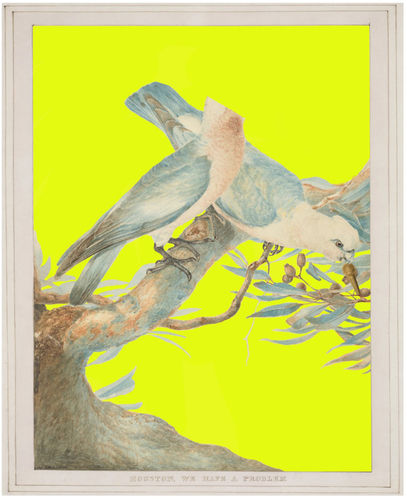
Titling her new exhibition after the narcissisms of colonial control – I like to name everything after myself – Ross critiques known history by obliterating existing tropes with her own unique and recognisable hand.
The title lands as both confession and accusation, pointing to the entitlement embedded in acts of naming, categorising, and claiming. In Ross’s hands, history is not a stable record, but a constructed narrative, one that can be interrupted, revised, and re-seen.
Joan Ross is consistently challenging the dominant narratives of history, questioning who writes it, what is written in, and what gets left out. She turns toward the mechanisms that shape cultural memory: the archive, the museum, the collection, and the image bank, where stories are arranged into systems that appear neutral, yet carry the biases of power. Ross returns to these inherited frameworks to expose their omissions, tracing how authority is built through selection, repetition, and the quiet erasure of other perspectives.
Focusing on collecting practices, I like to name everything after myself is a new body of work that explores the narcissism of colonial control. Ross critiques narratives by obliterating existing tropes, referencing existing imagery with her own twist and flourish of fluro, disrupting the familiar with a bright, insistent charge. Her interventions do not simply decorate the past, they rupture it, making visible the forces that have shaped what we think we know, and inviting viewers to question the comfort of “known” history.
