
My interest in art is, I imagine like many others, is not bound by whether it is found in the private or public domain, or exists within or outside gallery and museum spaces. Having recently made the move from a major state institution to the world of public art, however, I have noticed tangible differences in the reception of artists working across these two domains. In particular I’ve noticed the ways that an artist’s practice changes according to the challenges of each environment and the way the public response changes according to its context and setting.
Whereas in the contemporary museum or gallery an artist’s work is framed by the white cube of the gallery space and its value shaped by curatorial and collector interests, in the public realm the response to artwork is conditioned by its interaction with the built environment and frequently measured against the metrics of council spending, relevance and other infrastructure needs.
There are of course artists who manage to straddle the two worlds. Among them is Louise Zhang, a Sydney-based artist with family hailing from the small island of Qidu in Wenzhou, China. Graduating in 2016 from UNSW with a MA in fine art, she showed work at the NGV while simultaneously undertaking projects in public art.
Zhang’s early works explored publicly accepted norms related to beauty and kitsch through the genre of horror and other forms of popular culture. The issues of cultural identity as a child of migrant parents have also been a central theme of her work, further stimulated by two residencies in which she discovered the breadth and complexity of China’s vast cultural landscape.
It appears, however, that her interest in Chinese cosmology as it manifests in art, architecture and botany has been the most significant influence on her public art which explores the dynamic between colourfully painted surface, form and space. One of the three works by Zhang in the NGV collection made between 2018-2020 is an early sculptural experimentation inspired by the form of Chinese scholar rocks. Scholars Mounds #3 (2019) is an interesting example of the collision between Chinese tradition and Zhang’s love for flamboyant colour.
The sculptural and architectural components connected to the traditional Chinese scholar’s garden were further explored in her first forays into public art, commissioned in 2019 by the City of Sydney and Parramatta Artist Studios to make work to celebrate Lunar New Year and an activation at Batman walk respectively.
Even for Zhang who finds the transition between materials and the adoption of new materials an integral part of her creative development, moving between studio work and public art still presents challenges.
Reflecting on her painting practice, Zhang finds that while she can easily bring canvas, paint and colour together in a fluid process to make an image, her experiences in public art are more demanding as she navigates and negotiates external factors. Having said that, she believes public art provides opportunities to resolve painterly considerations and aesthetic decisions in ways that are affected by scale and immediacy to their publics that is not only different but an exciting and complementary mode of working to her studio practice.
Across her public and studio work, Zhang’s interests in Chinese gardens and shan shui landscape paintings underly her investigation of the relationship between natural elements and how this contemplation of the micro can help us better situate ourselves within the cosmos.
Historically, the landscape painter in China was celebrated as a cultivated figure who created idyllic images of contemplation and philosophical musing rather than faithful representations of the landscape. The paintings merge different perspectives not usually perceived by the human eye; as Zhang reminded me, ‘these are not real landscapes but imagined, as though seen by a bird’.
Designed to conjure the abode of sages, the vertically orientated scroll paintings operate as a kind of virtual reality where viewers can lose themselves in an imagined journey of spiritual and cultural enlightenment. Typically, the viewer’s eye is encouraged to follow a winding river from the foreground of the painting, into the craggy peaks where they can hide themselves away from the material world in the pursuit of more lofty concerns. The term shan shui, meaning ‘mountains and water’, became a central feature of literati paintings, used to describe the relationship between stillness and movement.
While maintaining this affection for the marriage of mountains and water and some of the pictorial devices for drawing one’s eye across the surface of the painting, Zhang has transformed this codified and ideal visual language into an explosion of colour.
In an interview with the developer Lendlease, Zhang describes colour as: ‘The greatest tool in painting’ and ‘the best way of manipulating perspective’. Her public artworks are designed to excite the senses within a lived experience of the urban environment - there are no airs of intellectual stuffiness or allusions to spiritual transformation found in Zhang’s vibrant works, but unabashed desire to bring joy and colour into the lives of all who view them.
Looking for meaning in Zhang’s work, colour has sometime been reductively interpreted as signifying an imagined feminine domesticity or sensibility. Equally, her use of colour has been relegated to more decorative domains, but for Zhang, colour has strong foundations in Chinese art with great historical implications that speak to cross-cultural dialogue, as exemplified by 17th and 18thcentury Europe’s fascination with Chinese art and aesthetics.
Reflecting more generally on the role of art and colour, Zhang feels that although art can reflect current cultural and societal changes, in both the gallery and public art world there is an increasing pressure to make art that speaks to contemporary issues. In fact, sometimes these things are invoked to legitimise a project. While Zhang makes clear she can only speak to her own personal experiences, she feels humour and joy are not attributed the same value and are regarded as less serious even though they can have a profound impact on our wellbeing.
So how does Zhang bring joy to the public? Movement is a big factor. From the genre of literati painting where the eye is encouraged to follow a bend in the river or a wispy cloud in the sky, Zhang’s public art is about creating spaces for bodily engagement - spaces for people to walk around, walk through, sit on and generally enjoy, creating meaning through their own movement. Her moon gates are a great example.
Historically, the moon gate was designed as a visual framing of the space beyond it. As an architectural intervention that creates spatial division between foreground, middle and background it enhances our awareness and aesthetic appreciation of the world around us. By helping to focus our eye on the cultivated landscape within the circular frame (echoing the ocular sphere) the world is perceived as image. This is an interesting manifestation of the inherent tension between culture and nature - or an ironic desire to know nature through an act of separation and control - and reveals a strange dynamic that exists between image and life that can cause many to confuse the two.
. However, this tension is collapsed as one walks through the moon gate and into the landscaped garden beyond. Upon approaching and entering the framed circle we pass through a threshold - the mirage is ruptured and the image is discarded in favour of a lived experience. In this way the gate operates as kind of portal between our imagination of the world and its lived reality and there is something wonderous about the moment when we cross from one to the other whether perceived or experienced unconsciously.
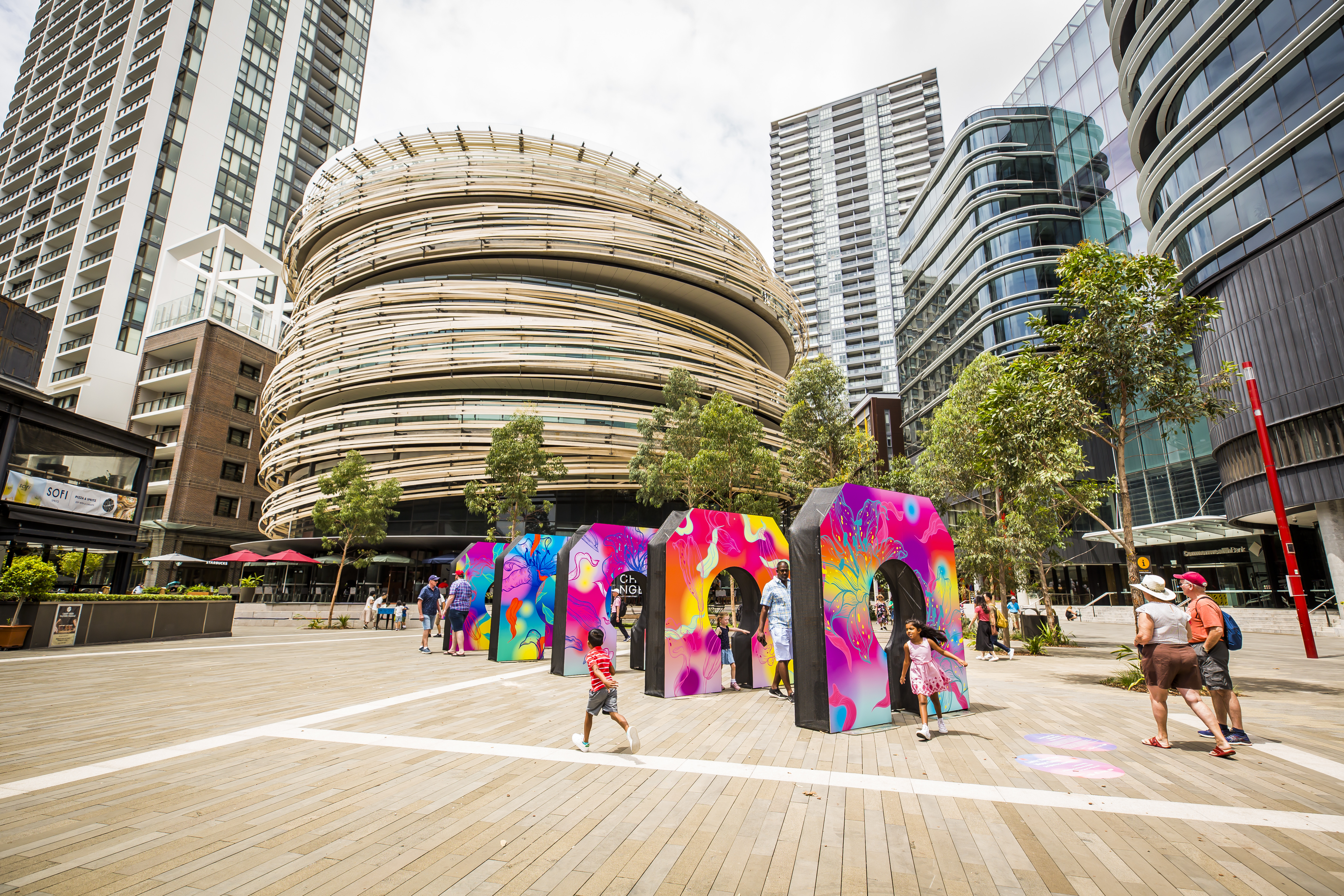
Zhang’s series Lunar New Year Moon Gates harnesses this collision of the real and imagined as a moment of delightful self-recognition. Surrounded by intense swirls of colour, each gate opening is aligned with the next to create a tunnel, and as visitors travel though the series of apertures they are seen and see themselves undertaking a passage signalling a metaphorical transition from one calendar year to another: a celebration of the old year passing and an embrace of the new.
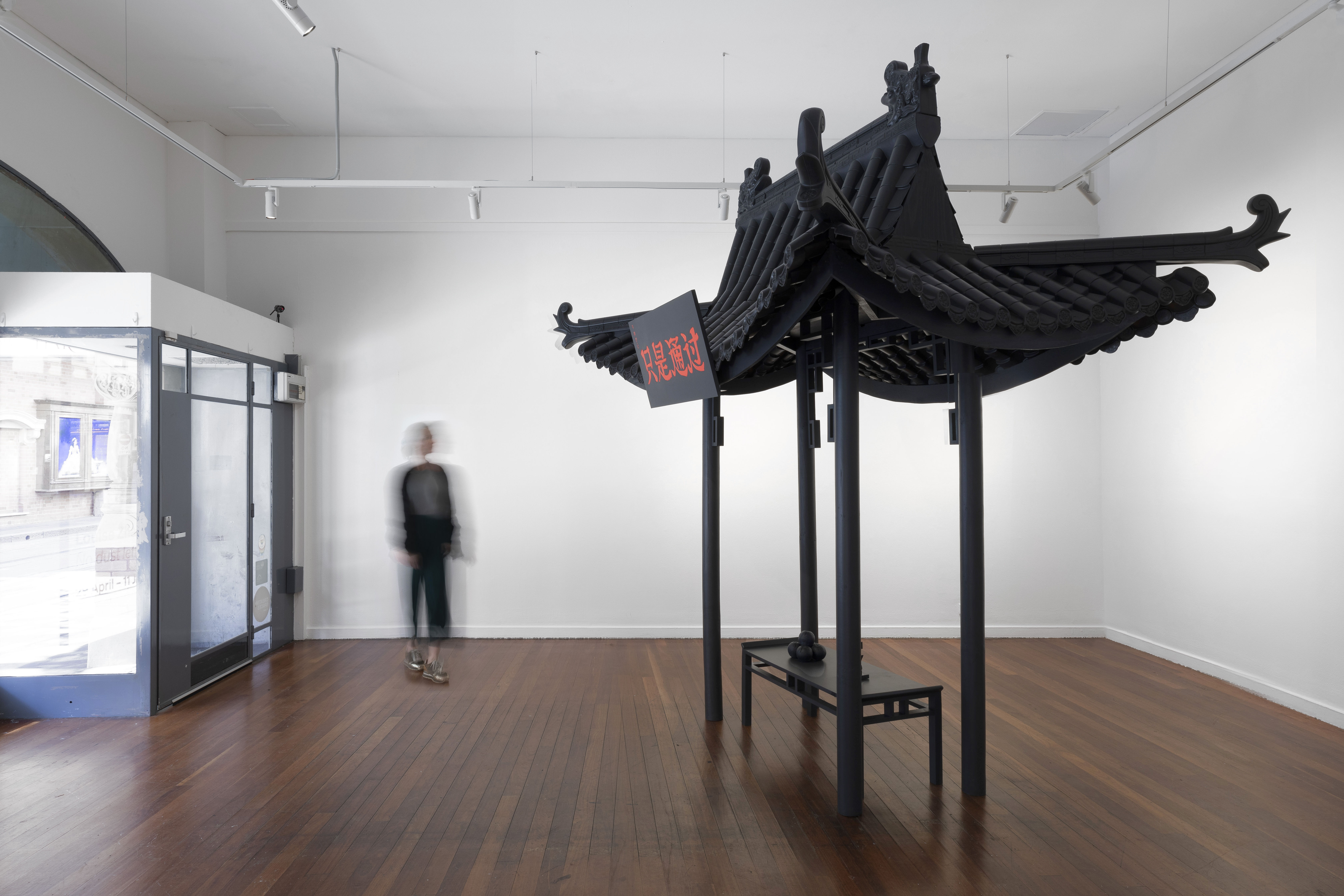
This idea of a symbolic threshold is also found in a paifong, or a traditional Chinese architectural gateway, designed as a practical division between different municipal zones. In Zhang’s 2023 show at Gallery 4A, Louise Zhang: No dust left in the lilies, she took the opportunity to explore the symbolic significance of this architectural device, borrowed from public spaces, in a gallery setting.
Zhang’s work Temple combined elements borrowed from a paifang with adornments emulating those from her family temple on Qidu. With assistance from family photographs, the temple was largely reconstructed from memory and serves to document this collaboration between generations. However, the opportunity to walk under the archway is prevented by what appears to be a small table with offerings. On closer inspection, one of the votives takes the form of a crucifix making reference to Christianity and to Zhang’s parents who forbad her entry, as practicing Christians, to the ancestral shrine. The symbolism of the portal is thereby denied and, as curator of the show Con Gerakaris writes: ‘Through its recreation in the gallery, [Zhang] attempts to rebuild what has been lost – a missing link between Zhang and her ancestors’.
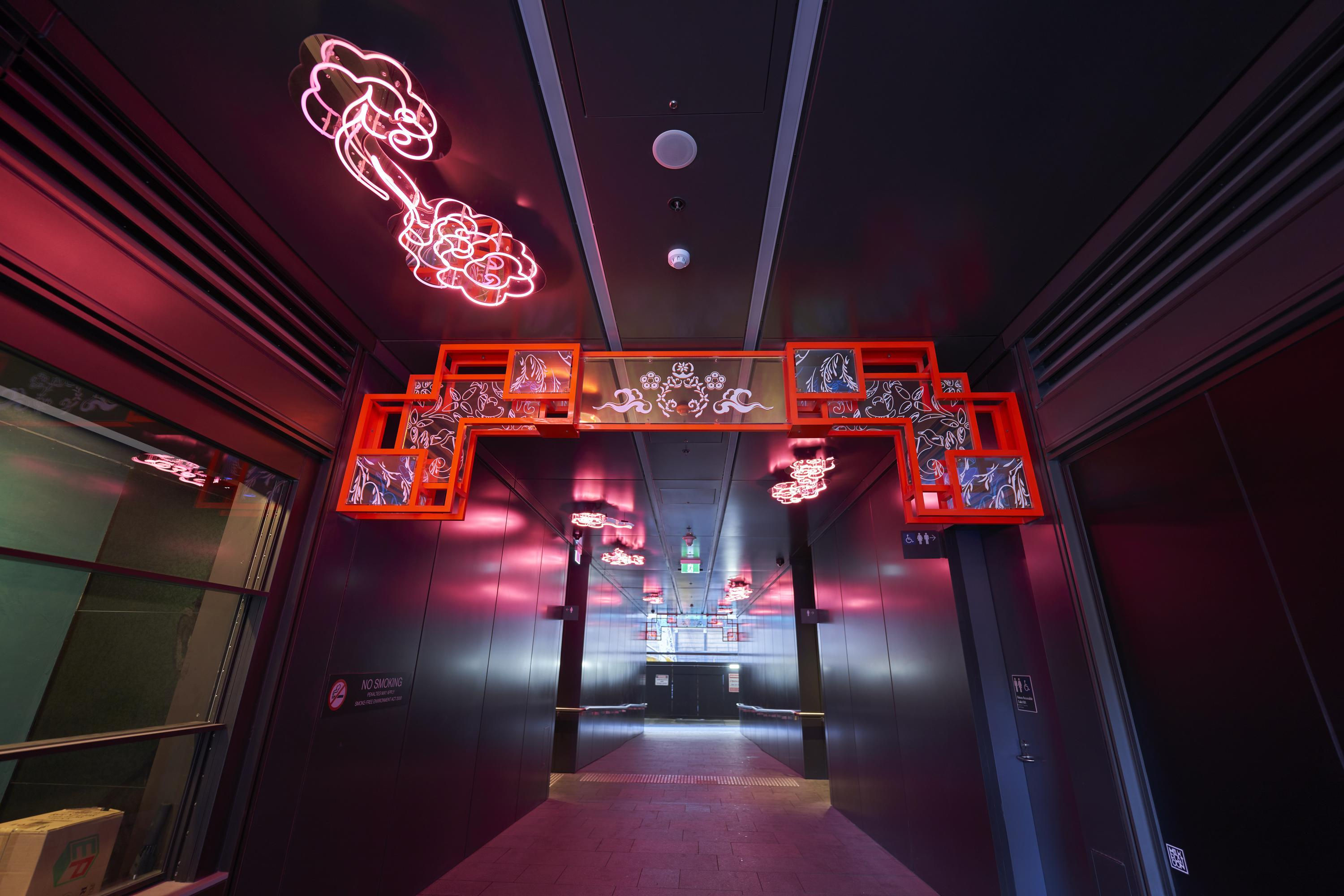
Made in the same year, Zhang’s work Hidden Realms commissioned by Lendlease for Sydney Place employs some similar architectural elements. Drawing inspiration from Chinese architectural openwork carving, Zhang created an arched frame surrounded by glowing neon clouds that float above passersby. Working with Kamilaroi/Gamilaraay artist, Dennis Golding, Zhang imbedded references to place within the frame in the form of the Gymea lily, native only to the Sydney region, and Willow tree branches, a Chinese symbol of friendship.
Following her interest in botany and the power of gardens to generate community, Zhang’s most recent work for the exhibition Celestial Tapestry at Fairfield City Museum & Gallery creates a space for connecting experiences of gardening and the cultivation of plants with her practice as an artist, both expressing ways to bring people together to share time and ideas. Here the spatial framing present in the moon gate and the architectural features present in Hidden Realms come together to enable the painted canvases to be self-supporting and free-standing.
The painted green timber frames support the movement of the painting off the wall and onto the floor. This simple gesture transforms the painted surface and encourages a bodily reading of the painting as an object to be navigated spatially, to be experienced while walking. By revealing the painting as an object with depth, volume and a verso the upright frame creates a tension between the two dimensionality of the surface and the architecture of the gallery space in a way that a work hung on a wall simply cannot. Similarly, the archival photos of market gardeners presented on an adjacent wall establish an interesting relationship between their spectral presence and the living plants growing in the middle of the gallery space that reminds us of the dynamic link between image and lived experience.
In this exhibition Zhang’s emphasis on community made with references to place, plants and people creates a landscape to be walked through not dissimilar to a shan shui landscape painting in which one is invited to wonder through an imagined landscape, and in doing so one is afforded an opportunity to reflect on its relationship to the larger world around them. As Zhang knows full well it is sometimes the bodily experience of ‘walking through’ an artwork that introduces the public to different ideas, offering moments of joy along the way.
Dr Matt Cox is Senior Curator and Artist Liaison at Tilt Industrial Design. He comes to Tilt from the Art Gallery of New South Wales where he was Curator, Asian Art. Matt regularly teaches subjects on contemporary art and curating at the University of Sydney and Monash University and has presented lectures on the intersection of public art, urban development and climate change.
Main image courtesy of the National Gallery of Victoria.
Image 1 courtesy of 4A Centre for Contemporary Art, photo by Anna Cucera,
Image 2 courtesy of 4A Centre for Contemporary Art, photo by Jessica Maurer.
Image 3 courtesy of Sydney Place / Lendlease, photo by Sam Moerke.
